ERNIE: Baidu's Strategic AI Model Transforming Knowledge Integration
This article takes an in-depth look at ERNIE, Baidu’s AI model, and explains how it differs from mainstream large language models by embedding structured knowledge directly into its architecture. Rather than focusing only on text prediction, ERNIE is designed to understand relationships, context, and factual information at a deeper level. The article explores how ERNIE works, where it performs best, its real-world applications, and when it may or may not be the right choice for developers and organizations.
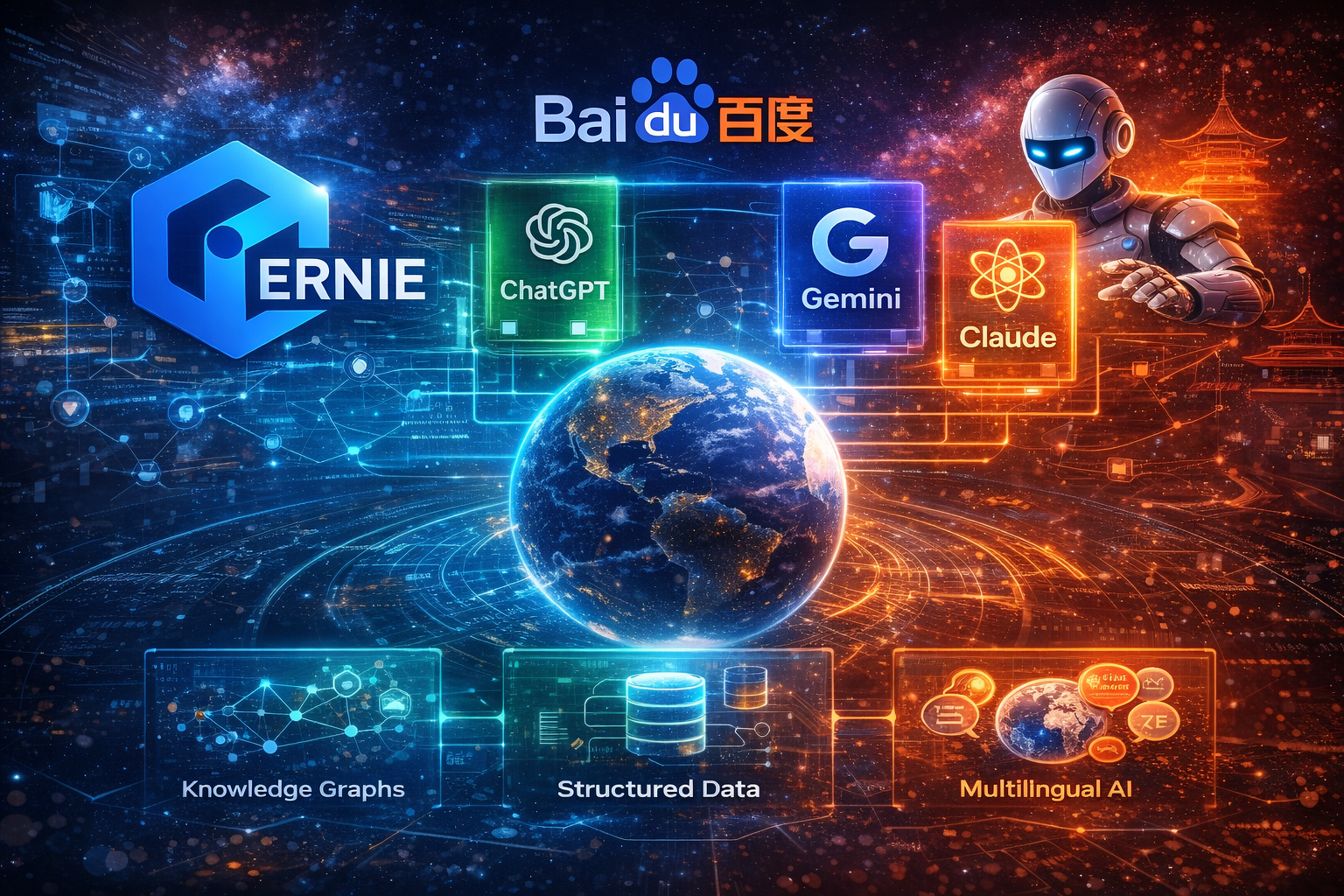
In an AI landscape dominated by Western names like ChatGPT, Claude, and Gemini, a powerful contender has been steadily advancing from the East: ERNIE (Enhanced Representation through kNowledge IntEgration) developed by Baidu, China's search giant. This model represents more than just another large language model—it embodies a fundamentally different approach to language understanding and knowledge processing.
While global attention often focuses on OpenAI's offerings, ERNIE has quietly evolved through multiple iterations, establishing itself as a sophisticated AI platform with unique capabilities in knowledge integration, multilingual processing, and contextual understanding. This comprehensive analysis explores not just what ERNIE does, but how it works technically, why its architecture matters, and what strategic advantages it offers in specific applications and markets.
From its origins as a research project to its current status as a commercial AI platform powering millions of interactions daily, ERNIE's journey reflects China's broader ambitions in artificial intelligence and offers insights into alternative approaches to AI development.
The Fundamental Challenges ERNIE Addresses in AI
Traditional large language models (LLMs) face several inherent limitations that ERNIE's architecture specifically targets:
- Knowledge Isolation: Most LLMs learn patterns from text without integrating structured knowledge
- Contextual Shallow Understanding: Surface-level pattern matching without deep semantic relationships
- Western Language Bias: Dominance of English training data limiting effectiveness in other languages
- Factual Inconsistency: Difficulty maintaining factual accuracy across extended conversations
- Limited Reasoning Capabilities: Challenges in complex logical and causal reasoning
ERNIE's core innovation addresses these issues through its foundational design principle: knowledge-enhanced pre-training. Unlike models that learn primarily from text corpora, ERNIE systematically integrates external knowledge graphs, structured databases, and semantic relationships during its training process.
This approach transforms AI from statistical pattern recognition to something closer to genuine understanding, particularly valuable in domains requiring factual accuracy and complex relationship mapping.
ERNIE's Technical Architecture: How It Processes Information Differently
ERNIE's technical superiority stems from its multi-layered architecture that processes information at multiple levels simultaneously:
- Knowledge Integration Layer: Continuously incorporates knowledge graphs during pre-training and fine-tuning
- Multi-Granularity Encoding: Processes characters, words, phrases, and entities as interconnected units
- Cross-Modal Learning Framework: Integrates text, knowledge graphs, and in later versions, visual information
- Hierarchical Attention Mechanisms: Differentiates between local syntactic patterns and global semantic relationships
- Continuously Evolving Training: Implements ongoing learning from new data and knowledge sources
The technical implementation involves several sophisticated components:
- ERNIE-KM (Knowledge Memory): A dedicated module that stores and retrieves factual knowledge during inference
- Dynamic Knowledge Injection: Real-time integration of updated information from knowledge bases
- Multi-Task Unified Framework: Single model architecture handling diverse NLP tasks without task-specific tuning
- Cross-Lingual Alignment: Deep semantic mapping between languages rather than surface translation
This architecture enables capabilities that distinguish ERNIE from conventional LLMs:
- More accurate factual responses with attribution to knowledge sources
- Better handling of complex queries requiring multi-step reasoning
- Superior performance in domain-specific applications
- Enhanced consistency in extended dialogues
ERNIE's Capabilities and Practical Applications
ERNIE has evolved through multiple versions, each expanding its capabilities and applications:
ERNIE Model Evolution:
- ERNIE 1.0: Introduced knowledge masking and entity-level understanding
- ERNIE 2.0: Added continual multi-task learning framework
- ERNIE 3.0: Integrated knowledge-enhanced and language model pre-training
- ERNIE 4.0: Latest version with significantly improved reasoning and creative capabilities
Core Capabilities:
- Advanced Natural Language Understanding: Superior performance on Chinese NLP benchmarks
- Knowledge-Intensive Question Answering: Accurate responses to factual queries with citation ability
- Multi-Lingual Processing: Strong performance across English, Chinese, and multiple Asian languages
- Code Generation and Analysis: Programming capabilities comparable to specialized code models
- Creative Content Generation: High-quality text generation in various styles and formats
- Complex Reasoning Tasks: Mathematical, logical, and analytical problem-solving
Commercial Applications:
- Search Enhancement: Powering Baidu's search engine with deeper semantic understanding
- Enterprise AI Solutions: Custom implementations for finance, healthcare, and legal sectors
- Educational Technology: Intelligent tutoring systems and personalized learning platforms
- Content Creation Platforms: Media and marketing content generation tools
- Customer Service Automation: Sophisticated chatbots with industry-specific knowledge
What makes ERNIE particularly valuable is its practical reliability in professional contexts. Its knowledge integration reduces hallucinations and improves factual accuracy, making it suitable for applications where precision matters.
Real-World Deployment Scenarios and Case Studies
1) Financial Services Implementation
Challenge: A major Asian bank needed AI-powered financial analysis tools that could process regulatory documents, analyze market trends, and generate investment insights with high factual accuracy.
ERNIE Solution: Custom-trained ERNIE model integrated with financial knowledge graphs containing company data, regulatory frameworks, and economic indicators.
Results: 40% improvement in document analysis accuracy compared to previous NLP systems, with particular strength in understanding relationships between regulatory changes and market impacts.
2) Healthcare Diagnostics Support
Challenge: Healthcare provider sought AI assistance for preliminary symptom analysis and medical literature research support.
ERNIE Solution: ERNIE 3.0 specialized with medical knowledge graphs, patient record analysis capabilities, and integration with medical research databases.
Results: Demonstrated superior performance in understanding complex medical terminology relationships and maintaining contextual accuracy in extended diagnostic conversations.
3) Cross-Business Communication Platform
Challenge: Multinational corporation needed AI-powered communication tools that could handle technical discussions across English, Chinese, and Arabic with consistent terminology understanding.
ERNIE Solution: Multi-lingual ERNIE implementation with specialized terminology knowledge bases for engineering, manufacturing, and supply chain domains.
Results: Significant reduction in miscommunication incidents and improved efficiency in cross-lingual technical documentation review processes.
4) Educational Content Personalization
Challenge: EdTech platform required adaptive learning system that could understand student responses at conceptual level rather than keyword matching.
ERNIE Solution: Integration of ERNIE with educational knowledge graphs covering curriculum standards, learning objectives, and conceptual relationships across subjects.
Results: More accurate identification of knowledge gaps and personalized learning path recommendations based on deep understanding of subject matter structure.
Common Implementation Mistakes and How to Avoid Them
- Treating ERNIE as ChatGPT Clone: Underestimating architectural differences leads to suboptimal implementation
- Ignoring Knowledge Graph Integration: Failing to leverage ERNIE's unique capability to connect with structured knowledge
- Overlooking Multilingual Advantages: Not customizing for specific language capabilities when relevant
- Insufficient Training Data Preparation: ERNIE's knowledge integration requires properly structured training data
- Neglecting Continuous Learning Setup: Not implementing mechanisms for ongoing knowledge updates
- Underestimating Computational Requirements: Knowledge-enhanced models have specific infrastructure needs
- Failing to Validate Factual Accuracy: Assuming all outputs are equally reliable without verification systems
Successful ERNIE implementation requires understanding its unique characteristics and designing systems that leverage its strengths rather than forcing it into patterns developed for different AI architectures.
When ERNIE May Not Be the Optimal Choice
Despite its sophisticated capabilities, ERNIE has specific limitations and contexts where alternative solutions might be preferable:
Technical Limitations:
- Western Cultural Context Gaps: While strong in Asian contexts, may have limitations in Western cultural references
- Specialized Western Domain Knowledge: May trail in very specific Western professional domains without customization
- Real-Time Processing Constraints: Knowledge integration can add latency in certain implementations
- Integration with Western Ecosystems: May require additional adaptation for seamless integration with certain Western SaaS platforms
Strategic Considerations:
- Primary Western Market Focus: If target audience is exclusively Western with no Asian dimension
- Regulatory Compliance Requirements: Certain jurisdictions may have specific requirements about AI systems
- Existing Investment in Alternative Ecosystems: High switching costs from established AI platforms
- Limited Technical Expertise: Teams without experience in knowledge graph integration may face steep learning curve
Practical Constraints:
- Budget Limitations: Custom knowledge integration requires investment in data structuring
- Timeline Pressures: Rapid deployment needs may favor simpler model architectures initially
- Scale Considerations: Very small-scale applications might not justify knowledge integration complexity
The decision should be based on specific use case requirements, target markets, available expertise, and strategic business objectives rather than technical capabilities alone.
Strategic Implementation Framework for ERNIE
- Comprehensive Needs Assessment:
- Evaluate knowledge-intensive requirements versus general conversational needs
- Assess multilingual requirements and cultural context needs
- Identify existing knowledge assets that could be integrated
- Determine factual accuracy requirements versus creative flexibility
- Architecture Planning:
- Design knowledge graph integration strategy relevant to your domain
- Plan for continuous knowledge updating mechanisms
- Determine optimal ERNIE version and configuration for your use case
- Design hybrid systems where ERNIE handles knowledge-intensive components
- Implementation Phasing:
- Start with focused pilot projects demonstrating knowledge integration value
- Gradually expand to more complex applications as expertise develops
- Implement rigorous validation systems for factual outputs
- Develop fallback mechanisms for scenarios where knowledge integration adds limited value
- Performance Optimization:
- Continuously refine knowledge graphs based on usage patterns
- Monitor and improve cross-lingual understanding where relevant
- Optimize inference efficiency while maintaining knowledge integration benefits
- Implement user feedback systems to identify knowledge gaps
- Scaling Strategy:
- Develop templates for knowledge integration in new domains
- Create training programs for teams working with ERNIE systems
- Establish governance frameworks for knowledge validation and updates
- Design modular implementations allowing component-level updates
Successful ERNIE implementation requires treating it as a knowledge-enhanced system rather than just a language model. The most successful deployments are those that maximize its unique capabilities while complementing them with other AI approaches where appropriate.
Conclusion: ERNIE's Strategic Position in the Global AI Landscape
ERNIE represents more than just another AI model—it embodies a fundamentally different approach to artificial intelligence that prioritizes knowledge integration alongside language understanding. While Western models have focused on scaling parameters and training data, ERNIE has pursued a path of architectural innovation that bridges the gap between statistical pattern recognition and genuine knowledge-based reasoning.
The strategic implications of ERNIE's approach are significant:
- Alternative AI Development Pathway: Demonstrates that scaling isn't the only path to AI advancement
- Domain-Specific Superiority: Offers compelling advantages in knowledge-intensive applications
- Multilingual and Multicultural Capabilities: Provides strong foundation for truly global AI systems
- Reduced Hallucination Risk: Knowledge grounding decreases factual errors in critical applications
For organizations operating in Asian markets or dealing with knowledge-intensive domains, ERNIE offers capabilities that are not just competitive but in some cases superior to alternative solutions. Its ongoing development under Baidu's substantial investment ensures continued advancement, with ERNIE 4.0 already demonstrating significant improvements in reasoning, creativity, and application versatility.
The future of AI is unlikely to be dominated by a single approach or architecture. Instead, we're seeing the emergence of specialized models optimized for different capabilities. In this diversified landscape, ERNIE has established a strong position as the leading knowledge-enhanced AI model, offering unique value that complements rather than merely competes with other approaches to artificial intelligence.
As AI continues to transform industries and societies, tools like ERNIE that prioritize accuracy, knowledge integration, and cross-cultural understanding will play increasingly important roles in professional, educational, and critical decision-making applications. The organizations that understand and leverage these differentiated capabilities will gain competitive advantages in an increasingly AI-driven world.